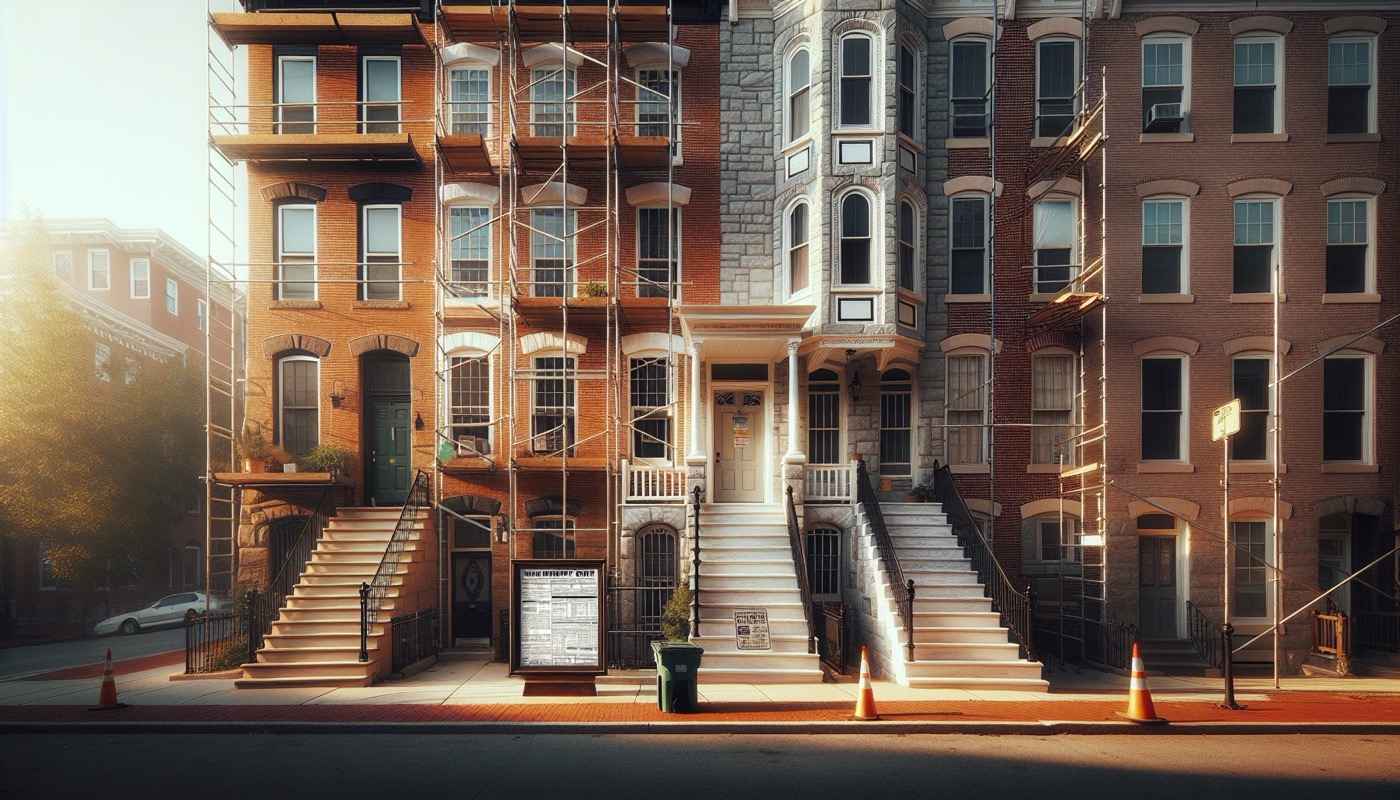
Baltimore is the largest city in Maryland and the only one in the state that administers its own construction code as a charter city. Where Montgomery County and Baltimore County operate under the Maryland Building Performance Standards with local amendments, Baltimore City adopts and enforces the Baltimore City Building Code directly, through the Department of Housing and Community Development (DHCD) Permits and Code Enforcement office — the permit authority for every interior, exterior, structural, and MEP job in the city.
DHCD is Baltimore's combined housing and permit agency. Within DHCD, the Permits and Code Enforcement (PACE) division administers permits, performs plan review, conducts inspections, and enforces the Building Code against vacant and substandard property. The city's permit system is CitizenAccess for online submittal — the portal replaced the legacy paper track in most categories several years ago.
Permit categories:
Baltimore adopts a current edition of the International Building Code as the Baltimore City Building Code with Baltimore-specific amendments (Article 32 of the Baltimore City Code). The city parallels the Maryland Building Performance Standards adoption cycle but retains its own amendment power as a charter city.
Key city-specific amendments (verify current version on a project basis — the amendments are revised with each code cycle):
Baltimore's Rehabilitation Code (historically inspired by New Jersey's Rehab Subcode) applies reduced requirements to work in existing buildings of specified vintage, making adaptive reuse less expensive than it would be under full new-construction standards.
The Commission for Historical and Architectural Preservation (CHAP) regulates exterior alterations, additions, and demolitions in Baltimore's designated historic districts and landmark properties. CHAP covers a substantial portion of the city — Fells Point, Federal Hill, Mount Vernon, Bolton Hill, Union Square, Old West Baltimore, and dozens more. Each district has district-specific design guidelines on top of CHAP's general rules.
Review levels:
A Building Permit cannot be issued in a historic district without a CHAP Notice to Proceed. Out-of-town developers routinely learn this late: the plans pass every DHCD review but cannot be issued because CHAP signoff was never pursued.
See our Baltimore CHAP Historic Review essay for the full walkthrough of the district designation process and the appeal path.
Baltimore's current zoning code is TransForm Baltimore, effective 2017. It replaced a 1971 ordinance. The code introduced form-based districts in several corridor overlays, consolidated residential zones, and modernized parking and use regulations. Discretionary relief is administered by the Baltimore Municipal Zoning and Appeals Board (BMZA), which hears variances and special exceptions.
Zoning gates at Baltimore City permit issuance. Plans are reviewed for zoning compliance as part of the permit cycle; a variance or special exception application runs separately through the Planning Department and BMZA.
Almost every Baltimore construction project needs a Minor Privilege permit or a construction-impact permit from the Department of Transportation for any work, structure, or encumbrance in the public right-of-way. DOT permits:
Minor Privilege requires an ordinance in some cases — a Council action granting the privilege — for long-term encroachments. Factor in the ordinance timeline for any project with a permanent encroachment.
Baltimore's Inclusionary Housing ordinance (adopted 2022, Council Bill 22-0195) applies affordability requirements to specified market-rate residential projects. Projects of 20 or more units that receive certain public support (PILOT, TIF, HFA financing, public land, LIHTC) must produce a percentage of affordable units at defined AMI bands, or pay an in-lieu fee.
The ordinance is administered jointly by DHCD and the Department of Planning. Inclusionary compliance is documented on a Declaration of Covenants recorded on title; compliance is ongoing.
Baltimore sits inside Maryland's lead-hazard-reduction regime (the Reduction of Lead Risk in Housing Act, Environment Article § 6-801 et seq.), which applies statewide to rental units built before 1978 and has been extended to newer units in stages. Rental rehab projects in Baltimore must meet the Maryland Department of the Environment's lead-hazard-reduction standards and register with MDE. See our EPA RRP essay for the federal overlay and the MDE standards that exceed it.
Baltimore runs three parallel permitting tracks for most projects. DHCD for the Building Code. CHAP for historic exterior work. DOT for right-of-way. Missing any of the three stops issuance. Add BMZA for any discretionary zoning ask and Inclusionary Housing for market-rate residential with public support.
The most frequent out-of-town misconception is that Baltimore works like Baltimore County or Howard County. It does not. The city has its own Building Code, its own historic commission with teeth, its own zoning code, its own DOT, and its own inclusionary regime. Budget the calendar for each.
Primary sources for this essay: Baltimore City Code Article 32 (Building Code) and the Baltimore City Building, Fire, and Related Codes; Baltimore City DHCD Permits and Code Enforcement; TransForm Baltimore (Baltimore City Zoning Code); Baltimore City Code Article 6 (Historic Districts and CHAP); Council Bill 22-0195 (Inclusionary Housing); MD Environment Article § 6-801 et seq. (Reduction of Lead Risk in Housing Act). CitizenAccess is the permit portal; CHAP guidelines are published by district.