Maryland's Pre-Bid Contractor Registration
Maryland requires contractors and subcontractors to register with the state Prevailing Wage Unit before bidding or working on covered public works projects. The word "before" is doing the work in that sentence. This isn't a payroll registration you catch up on during the first pay cycle — it's a pre-bid gate that can disqualify an otherwise winning bid if missed. For out-of-state contractors accustomed to Pennsylvania, Delaware, New Jersey, or Virginia — none of which enforce a comparable pre-bid mechanism on prevailing wage — this is the most expensive surprise in the Mid-Atlantic.
What the requirement actually is
Under Maryland's Prevailing Wage Law (State Finance and Procurement Article, Title 17, Subtitle 2) and the implementing regulations in COMAR Title 09, Subtitle 12, Chapter 07, contractors and subcontractors performing work on covered public works projects must register with the Maryland Department of Labor's Prevailing Wage Unit. The registration is administered through the MD Prevailing Wage Portal and is a prerequisite for bidding on covered contracts — not a post-award compliance step.
Registration requires business identification, contact information, and certification that the entity will comply with the state's prevailing wage requirements on covered work. It runs alongside — but is distinct from — MHIC licensure, state business licensing, and state trade licensing. Each is its own track with its own prerequisites.
Why MD does it this way when neighbors don't
Maryland's regulatory posture on public-works contracting is notably more structured than most Mid-Atlantic states. MD operates the Prevailing Wage Portal as a unified system covering rates, registration, certified payroll submission, and complaint intake — all under one Prevailing Wage Unit. Pre-bid registration is how the state ensures that only registered contractors are eligible to compete on covered work.
Compare:
- Delaware — rates issued per project on request; no pre-bid registration required specifically for prevailing wage.
- Pennsylvania — open rate database, no pre-bid contractor registration with DLI for prevailing wage purposes.
- New Jersey — NJ Wage Hub registration for certified payroll filing, but that's post-award. No pre-bid registration requirement.
- Virginia — DOLI publishes determinations, no pre-bid contractor registration for prevailing wage.
- Maryland — mandatory pre-bid registration through the Prevailing Wage Portal.
The Mid-Atlantic footprint's one outlier. Contractors operating in MD routinely, or expanding into MD from neighbors, need to internalize this.
What happens if a contractor bids without registering
A contractor who submits a bid on a covered MD public works project without having registered with the Prevailing Wage Unit:
- Has the bid potentially disqualified by the awarding public body (the state, a county, or a municipality letting the contract).
- If the disqualification is caught at bid evaluation, loses the opportunity to that project.
- If the disqualification is discovered post-award but pre-execution, the contract may be voidable.
- If discovered post-execution, the contractor faces compliance enforcement in addition to contract-performance issues.
In none of those scenarios is "we'll register now" a complete remedy. The registration requirement attaches to the bid, not to the project.
Subcontractors register separately
Maryland's registration applies to subcontractors as well as primes. Each sub performing covered work on the project is independently registered. The prime contractor does not cover the subs' registrations by extension. This means:
- Prime contractors bidding MD public works need every tier of covered subcontractor to be registered.
- A prime that wins the bid and then discovers its mechanical sub or electrical sub isn't registered with the Prevailing Wage Unit faces a mid-project compliance problem.
- Checking subcontractor registration should be part of sub qualification and buy-out, not discovered at certified-payroll filing time.
Practical workflow: build registration verification into your subcontractor qualification template for MD work. A quick Portal search confirms status; it's not burdensome but has to happen.
Register early, not close to bid
First-time registration through the MD Prevailing Wage Portal is a one-time administrative process that takes some lead time — document gathering, online setup, Prevailing Wage Unit confirmation. For contractors new to MD public works:
- Don't wait for a specific bid opportunity to start registration.
- Plan for business-entity documentation, principal information, and insurance/bonding evidence if required.
- Registration typically persists — once registered, the contractor stays registered as long as current obligations (renewals, updates) are met.
- Lapses in active registration disqualify future bids the same way initial non-registration does.
For contractors with existing MD activity: verify registration is current before submitting the next bid. Renewal lapses are the most common bite after first registration.
How the Portal works operationally
The Maryland Prevailing Wage Portal is a unified online system:
- Contractors create an account and complete business registration.
- Registered contractors can search published wage rates for specific crafts, counties, and project types.
- After project award, contractors link to the specific project within the Portal.
- Certified payroll is submitted weekly through the Portal.
- Supplemental rate requests (for classifications not on the published schedule) are filed through the Portal.
- Complaint filing and resolution moves through the Portal.
One system, multiple workflows. The pre-bid registration is the entry point to all of it; everything else depends on having registration in place.
MHIC vs Prevailing Wage Unit — two different registrations
For contractors who also do home improvement work in MD, Maryland runs two distinct contractor-facing registrations:
- MHIC licensure — Maryland Home Improvement Commission license for home improvement work. Exam required. Guaranty Fund participation. See our Maryland Contractor Licensing Navigator.
- Prevailing Wage Unit registration — separate, for public-works prevailing wage purposes.
A home improvement contractor who occasionally bids small MD public works needs both. They don't substitute for each other.
Bid package implications
The awarding public body on a covered MD public works project typically requires bid packages to include:
- Contractor's Prevailing Wage registration number (or evidence of registration).
- Acknowledgment of prevailing wage requirements.
- Proposed subcontractor list with their registration numbers where applicable.
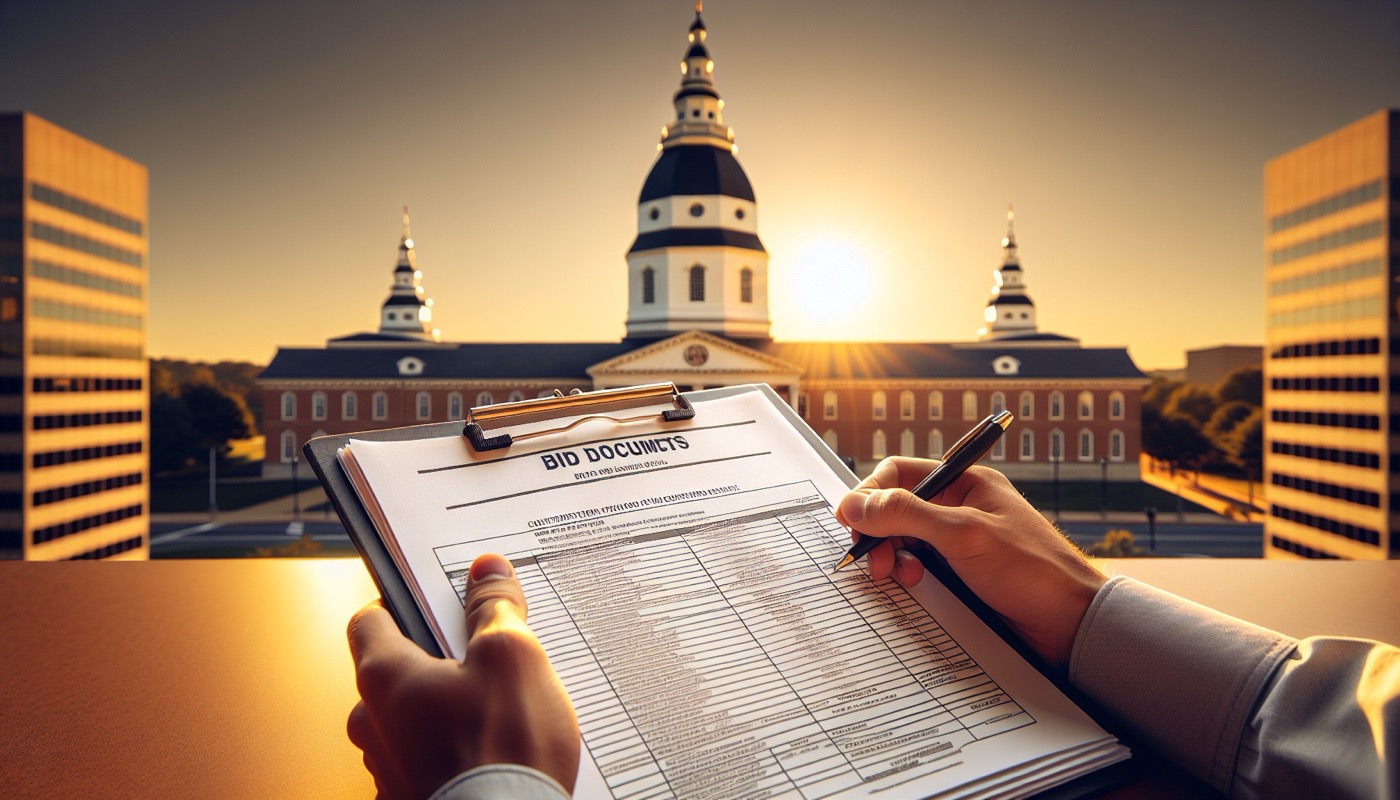
Bid documents specify this at the public body level; missing it is a bid-form deficiency separate from (but often catching) the underlying registration failure.
What to do with this
If you're new to MD public works: register before your first bid, not during. Document the process for internal compliance records. Train estimating staff to verify registration status as a bid-pursuit checklist item.
If you're already active in MD: verify your registration is current right now. Set a calendar reminder for renewal well before expiration. Verify your standard sub-bidders are registered — and set a standard clause in sub-qualification requirements.
If you're a prime contractor evaluating bids from subs for a MD public-works project: make sub registration status a bid-qualification item. A sub who offers a low number but isn't registered is not a valid option.
For the full MD prevailing wage framework and primary-source links, see our Maryland Prevailing Wage Navigator. For cross-state comparison showing MD's distinctive posture, see Mid-Atlantic Prevailing Wage Compared.
About The Hive
The Hive builds tools and publishes essays for working construction and MEP professionals in the Delaware Valley and Mid-Atlantic. Primary-source-grounded, practitioner-voiced, free to use.