OSHA Fall Protection in Construction: The 6-Foot Rule and the Systems Behind It
Fall protection is consistently OSHA's most-cited construction standard, year after year. 29 CFR 1926 Subpart M establishes the framework: fall protection is required for any walking/working surface with an unprotected side or edge 6 feet or more above a lower level. Three primary system types — guardrail, safety net, Personal Fall Arrest System (PFAS) — with specific design criteria. Low-slope and steep roof rules differ. Stairs and ladders (Subpart X) have their own triggers and dimensions. For GCs and specialty subcontractors, understanding the standard precisely rather than generally is what separates adequate from bulletproof compliance.
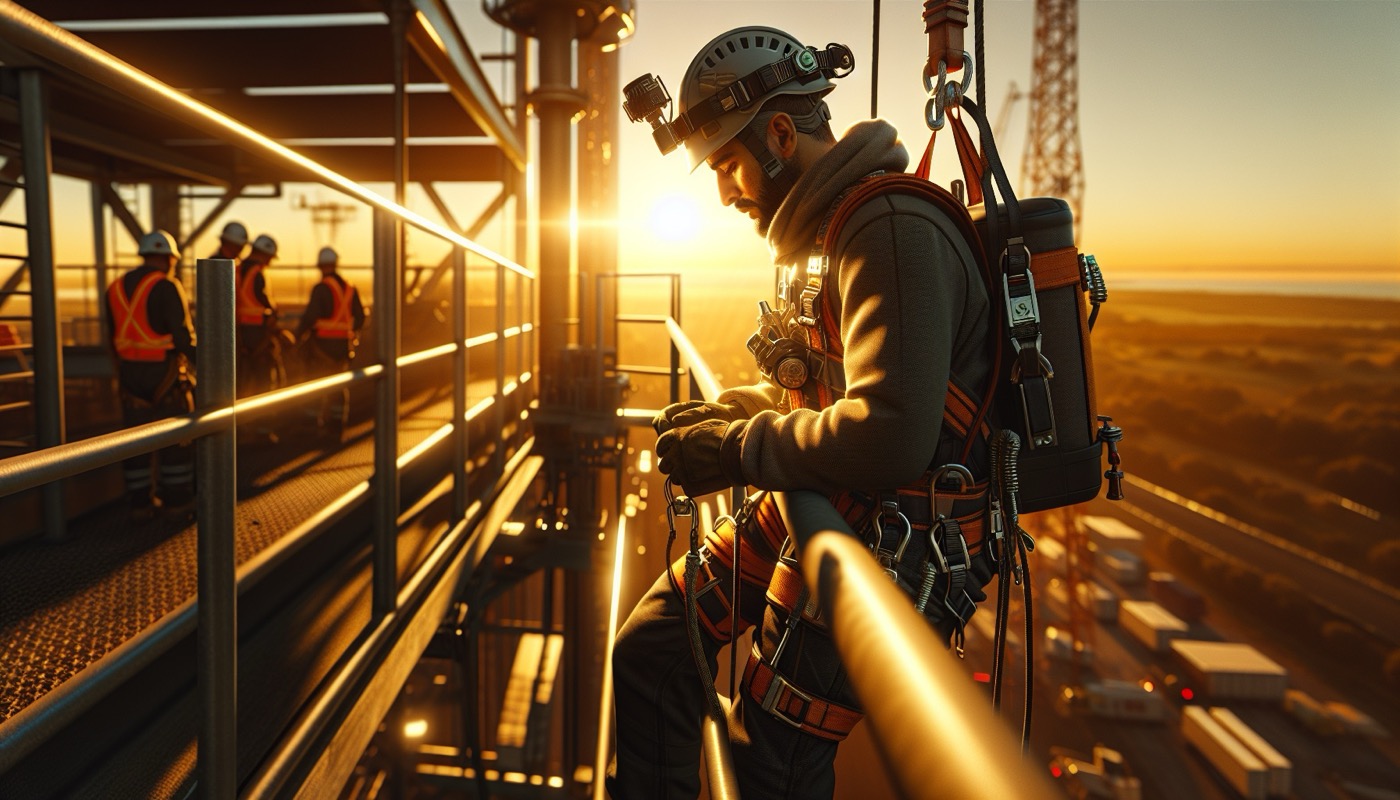
The 6-foot trigger
The foundational rule of Subpart M:
- Fall protection required for employees on walking/working surfaces with unprotected sides or edges 6 feet (1.8 m) or more above a lower level.
- Also applies to holes, leading edges, hoist areas, dangerous equipment.
- Specific lower triggers exist for certain categories (e.g., scaffolds — 10 feet under Subpart L).
- Steel erection has its own specific Subpart R framework with different triggers.
Primary source: osha.gov/laws-regs/regulations/standardnumber/1926/1926SubpartM.
Fall protection system options
Guardrail systems
- Top rail: 42 inches (±3 inches) above walking/working level.
- Midrail: midway between top rail and surface.
- Strength: must withstand 200-pound force applied outward or downward.
- Toeboard required where tools, materials, or workers could fall onto people below.
- Most common approach for permanent edges on decks, mezzanines, platforms.
Safety net systems
- Installed as close as practicable under the walking/working surface.
- Never more than 30 feet (9.1 m) below.
- Drop testing or certification required.
- Common for bridge work, large-scale steel erection.
Personal Fall Arrest Systems (PFAS)
- Designed and set up to prevent employee free fall beyond 6 feet or contact with any lower level.
- Full-body harness only — body belts are not permitted.
- Anchorage strength: capable of supporting 5,000 pounds per employee attached, or designed/installed/used under supervision of a qualified person with safety factor ≥ 2.
- Connectors: lanyards, deceleration devices, shock absorbers.
- Inspection required before each use.
Low-slope vs steep-slope roof rules
Low-slope roof (4:12 or less)
For employees doing roofing activities on unprotected sides/edges 6+ feet high:
- Guardrail systems, or
- Safety net systems, or
- Personal fall arrest systems, or
- Combination of warning line system + guardrail/safety net/PFAS/safety monitoring system.
- On roofs 50 feet or less wide: safety monitoring system alone is permitted.
Steep roof (greater than 4:12)
More restrictive — employees on steep roofs with unprotected edges 6+ feet high must use:
- Guardrail systems with toeboards, or
- Safety net systems, or
- Personal fall arrest systems.
- Warning line systems alone are NOT permitted on steep roofs.
The 4:12 boundary matters. A 4:12 roof qualifies as low-slope; 5:12 is steep. Roofers misreading this boundary lose the safety monitoring / warning line alternative.
Subpart X — Stairways and Ladders (29 CFR 1926.1050-1060)
General access requirement
Stairway or ladder required at all personnel points of access where there is a break in elevation of 19 inches (48 cm) or more and no ramp, runway, sloped embankment, or personnel hoist is available.
Ladder requirements
- Portable ladders extend at least 3 feet above the landing surface.
- 4-to-1 angle — for every 4 feet of height, base sits 1 foot from the wall.
- Fixed ladders over 24 feet require a cage, well, or ladder safety device (PFAS).
- Three points of contact maintained at all times while climbing.
- Ladders inspected for defects before each use.
- Metal ladders prohibited in areas where contact with energized electrical equipment is possible.
Stairway requirements
- Temporary stairways between levels where permanent stairs aren't yet in place.
- Handrails and guardrails on stairways with 4 or more risers, or rising more than 30 inches.
- Risers and treads consistent; variations not to exceed ¼ inch.
Training and documentation
29 CFR 1926.21 and 1926.503 set training requirements:
- Fall Protection Plan where conventional fall protection is infeasible — documented, site-specific.
- Competent Person designation — authority to take corrective action for hazard abatement.
- Qualified Person — specific certifications for PFAS design or anchorage supervision.
- Employee training records — hazard recognition, system use, inspection procedures.
- Retraining required when changes in workplace or equipment make previous training obsolete.
Common fall hazards and controls
| Hazard | Typical control |
|---|---|
| Unprotected floor edges | Guardrail system along all edges |
| Floor holes / openings | Cover rated for load; guardrail if cover not feasible |
| Roof edges (low-slope) | Warning line + guardrail/safety net/PFAS/monitor |
| Roof edges (steep) | Guardrail with toeboards, safety net, or PFAS |
| Leading edges | Guardrail, safety net, PFAS, or Fall Protection Plan |
| Open-sided decks | Guardrail system |
| Excavations >6 feet | Guardrail, fence, or barricade |
| Scaffolds | Subpart L trigger at 10 feet; guardrail or PFAS |
Multi-employer site responsibility
Fall protection gaps are one of the most common scenarios for OSHA's Multi-Employer Citation Policy (see our OSHA Multi-Employer essay). A missing guardrail cited as Creating (the firm that removed it), Exposing (anyone whose workers were near), Controlling (typically the GC), and possibly Correcting (a safety subcontractor with fall-protection maintenance obligations). GC documentation of the reasonable-care standard matters.
Common contractor missteps
- Failing to maintain guardrails removed temporarily for material loading — leaving gaps.
- Using body belts in PFAS. Not permitted since 1998. Full-body harness only.
- Inadequate anchorage — not 5,000-lb rated and not designed by a qualified person.
- Warning line systems on steep roofs. Not permitted.
- Calculating free-fall distance incorrectly — harness-to-anchorage vertical plus shock absorber deployment.
- PFAS that allows contact with lower level. The system must prevent this, not just arrest the fall.
- Missing training documentation. Records required; surprise inspections ask to see them.
- Rescue plans absent. OSHA guidance requires prompt rescue; prolonged suspension trauma is real.
Relevance across the Mid-Atlantic
Federal OSHA administers fall protection directly in DE, PA, NJ, VA. Maryland has a state plan for public-sector work; private-sector construction in MD is covered by federal OSHA.
Related standards:
- 29 CFR 1926.20 — general safety and health provisions, including safety program requirements.
- 29 CFR 1926.454 — scaffold training.
- 29 CFR 1926 Subpart L — scaffolding (10-foot trigger).
- 29 CFR 1926 Subpart R — steel erection (specific trigger heights).
- 29 CFR 1910 (general industry) — different rules apply to completed facilities.
What GCs and subcontractors should do
If you're a GC: site-specific Fall Protection Plan, documented Competent Person, regular inspection cadence, hazard-abatement authority in subcontract agreements.
If you're a subcontractor: trained workers, inspected equipment, PFAS properly configured, clear communication on fall hazards.
If you're a specialty fall-protection contractor: certification maintenance, documented engineer-approved anchorage designs where applicable.
If responding to a citation: 15-working-day Notice of Contest window; preserve options.
For the broader OSHA framework and contractor licensing context, see our essays on OSHA Multi-Employer, NESHAP Asbestos, and EPA RRP.
About The Hive
The Hive builds tools and publishes essays for working construction and MEP professionals in the Delaware Valley and Mid-Atlantic. Primary-source-grounded, practitioner-voiced, free to use.