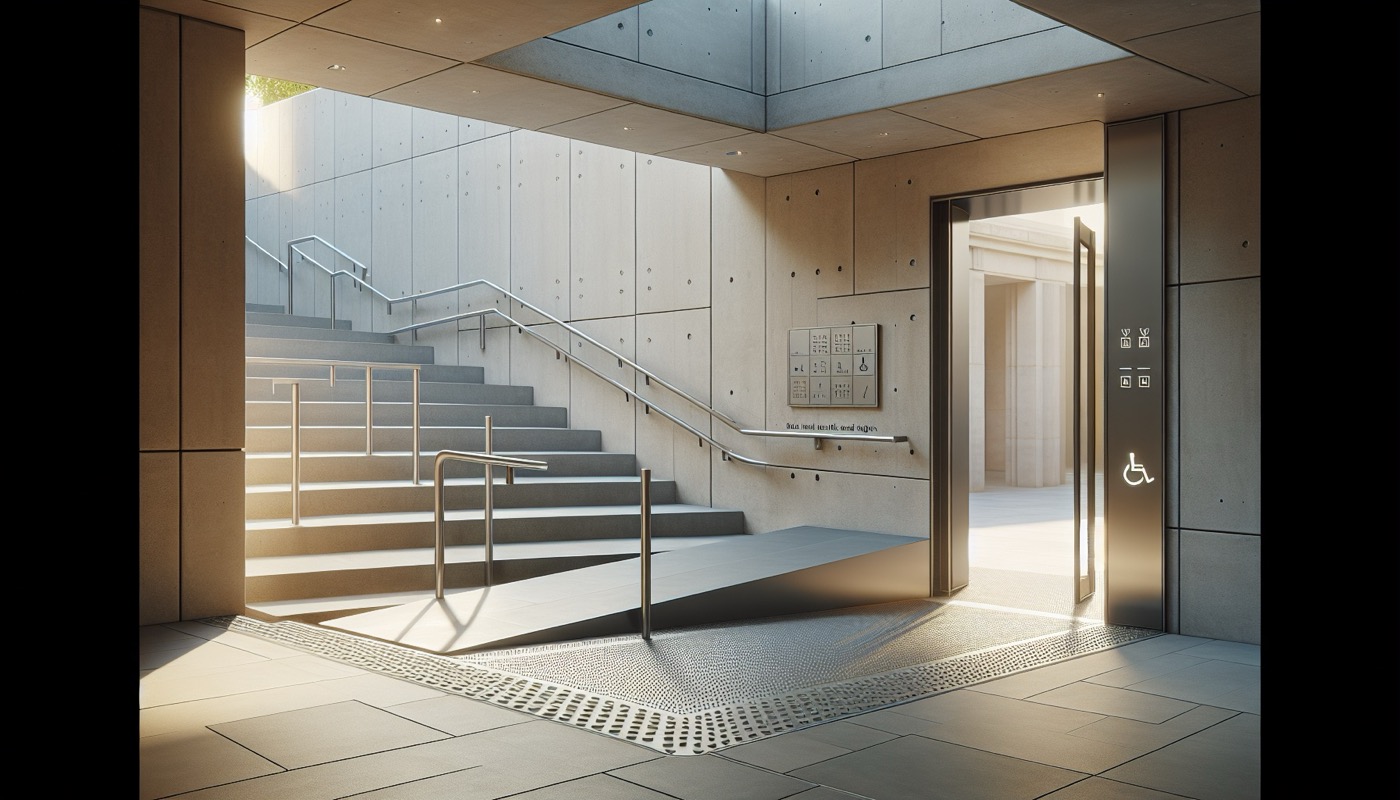
Accessibility in construction is governed by two federal layers: the Americans with Disabilities Act (ADA, 42 U.S.C. § 12101 et seq.) and — for federally-funded work — Section 504 of the Rehabilitation Act and the Architectural Barriers Act. For most private construction, the operative layer is the ADA, implemented through Department of Justice regulations at 28 CFR Part 36 and the 2010 ADA Standards for Accessible Design.
The ADA is a civil rights law, not a building code. Building officials do not issue "ADA permits." Compliance is self-certified by the design professional and enforced through (a) private lawsuits under Title III, (b) DOJ investigation and consent decrees, and (c) — for places of public accommodation — state human rights commissions. A project that passes state building-code review with flying colors can still be found noncompliant with ADA in federal court two years later.
Title III has two construction-relevant obligations: (1) new construction and alterations must comply with the 2010 ADA Standards; (2) existing facilities must remove architectural barriers where removal is "readily achievable."
The 2010 ADA Standards superseded the 1991 ADA Accessibility Guidelines (ADAAG) on March 15, 2012. All new construction and alterations commenced after that date must meet the 2010 Standards.
The 2010 Standards have two parts:
Technical provisions cover accessible routes, entrances, doors and doorways, ramps, stairways, elevators, plumbing fixtures (toilet rooms, bathing facilities, drinking fountains), signage, alarms, transient lodging, recreational facilities, and more. Dimensions are prescriptive: 36-inch minimum accessible route width, 48-inch maneuvering clearances at doors in certain configurations, 1:12 maximum ramp slope, 5-foot landings, 34–38-inch grab bar heights.
The standards apply differently depending on what you are doing.
Full compliance with the 2010 Standards, as scoped in Chapter 2. All elements in the scoping table — building entrances, accessible routes, accessible toilet rooms, accessible workstations per the calculation tables — must be provided at the quantities and locations specified.
"Alteration" is a defined term in 28 CFR § 36.402 — a change that affects or could affect the usability of the building or facility or any part thereof. Normal maintenance, reroofing, painting, wallpapering, asbestos removal, or changes to mechanical/electrical systems that do not affect usability are not alterations.
Alterations must be accessible "to the maximum extent feasible." Technical infeasibility is a narrow exception: something is technically infeasible only if the nature of the existing facility (structural elements, scope limited to non-structural elements) makes full compliance virtually impossible. Cost is not technical infeasibility.
When you alter a "primary function area" (an area where a major activity for which the facility is intended is carried out — dining, sales, classrooms, medical treatment), an accessible path of travel to the altered area — including accessible restrooms, telephones, and drinking fountains serving that area — must be provided to the extent that the added accessibility does not exceed 20% of the cost of the primary alteration. 28 CFR § 36.403(f).
This is the rule most often missed on tenant fit-outs. A $1M tenant improvement may trigger up to $200,000 of path-of-travel accessibility work outside the tenant space.
For facilities that predate the ADA and have not been altered, Title III still requires removal of architectural barriers where "readily achievable" — defined in 28 CFR § 36.104 as "easily accomplishable and able to be carried out without much difficulty or expense." Factors include cost, financial resources of the covered entity (not just the site), and the overall impact on operations.
This is the ongoing obligation that produces most of the landscape of Title III private lawsuits: an existing restaurant is sued because a single step at the entrance has never been removed, or because parking striping does not meet the current spec. The readily-achievable test is fact-specific, and courts have applied it unevenly across circuits.
The 2010 Standards include a safe harbor: elements in facilities built or altered in compliance with the 1991 ADAAG are not required to be modified to the 2010 Standards until the element is separately altered. 28 CFR § 36.304(d)(2). An owner can stop there — unless and until a renovation touches the element. Once you touch it, the 2010 Standards apply to that element.
There is no general safe harbor for "we built it to code." ADA is federal civil-rights law; compliance with a local or state building code does not create a defense. Every design must verify against the 2010 Standards independently.
Every Mid-Atlantic state's building code references accessibility requirements that overlap — but do not replicate — the ADA. ICC/ANSI A117.1 — Accessible and Usable Buildings and Facilities is the technical standard adopted by reference in the IBC. Requirements align with the 2010 Standards on most dimensions but are not identical in every scoping provision.
Practical reality: designers must comply with whichever standard is stricter on each element, because neither regime provides a defense for violating the other. A state-code-compliant toilet room that does not meet the 2010 Standards' maneuvering-clearance scoping can still produce a Title III claim.
Some states (including Maryland and Virginia at various points) have sought DOJ certification of their state accessibility code as equivalent to the ADA for purposes of creating a rebuttable presumption in enforcement actions. Certification has been granted for a small number of state codes in narrow windows; confirm the current status with the state accessibility program at design time.
Title III applies to 12 categories of private entities open to the public, listed in 28 CFR § 36.104. In summary: places of lodging; establishments serving food or drink; places of exhibition or entertainment; places of public gathering; sales or rental establishments; service establishments (banks, barber shops, lawyer offices); stations used for specified public transportation; places of public display or collection; places of recreation; places of education; social service center establishments; and places of exercise or recreation.
Mixed-use buildings: residential portions are generally not Title III (handled instead under Fair Housing Act design and construction requirements for covered multifamily), but the retail, office, and amenity spaces open to the public typically are.
Covered multifamily dwellings — buildings of 4 or more units — built for first occupancy after March 13, 1991, must meet the seven design and construction requirements of the Fair Housing Act (42 U.S.C. § 3604(f)(3)(C) and the HUD Fair Housing Act Design Manual). Requirements cover accessible entrance, accessible route, usable doors, accessible public and common areas, usable kitchens and bathrooms, reinforcement for later grab bar installation, and light switches/outlets in accessible locations.
Seven HUD-recognized safe harbors exist — design according to any of them (including the 1991 ADAAG with exceptions, ICC A117.1-2003 with the Fair Housing Act supplement, or the 2009 IBC as modified) creates a compliance safe harbor. FHA is enforced by HUD and by private plaintiffs.
ADA compliance is a design responsibility that survives the building permit. Three practical rules:
A state-code-approved drawing is not an ADA-compliant drawing. Two independent verifications — state code and 2010 Standards — are the defensible approach.
Primary sources for this essay: Americans with Disabilities Act (42 U.S.C. § 12101 et seq.); 28 CFR Part 36 (DOJ Title III regulations); 2010 ADA Standards for Accessible Design; ICC/ANSI A117.1 (as adopted in the IBC); Fair Housing Act (42 U.S.C. § 3604(f)(3)(C)) and the HUD Fair Housing Act Design Manual. The US Access Board and DOJ's ADA.gov guidance documents are the practitioner-facing companions.