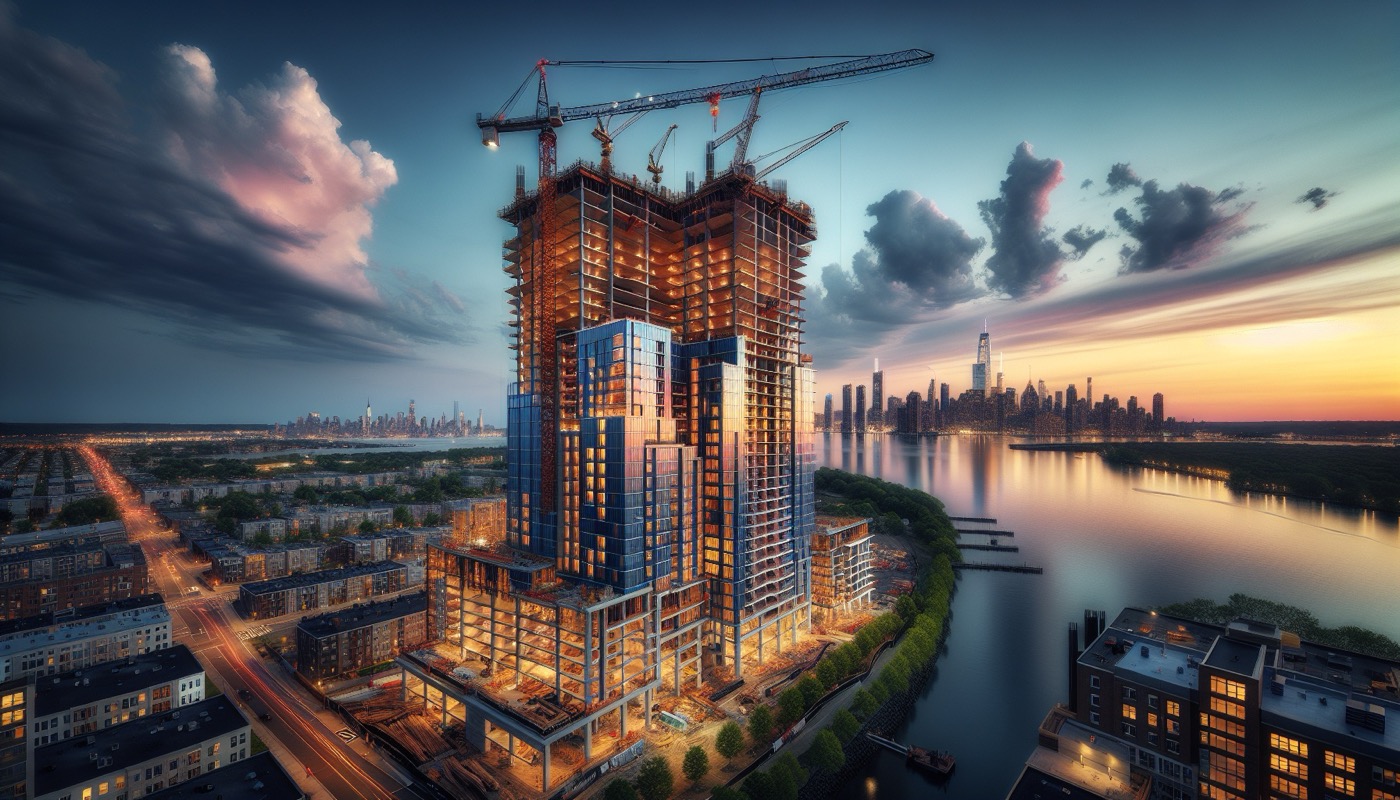
Jersey City is New Jersey's second-largest city, the state's office and residential gateway across the Hudson from Manhattan, and — along with Newark — one of the two most active permit markets in the Garden State. The city's skyline was rewritten over the past decade with high-rise residential, office, and mixed-use construction concentrated along the Hudson waterfront, the Journal Square area, and the Bergen-Lafayette redevelopment corridors. The permit system that shaped that boom runs through the Division of Construction, the Division of City Planning, the Planning Board and Zoning Board of Adjustment, and the Historic Preservation Commission (HPC).
Jersey City, like every New Jersey municipality, enforces the New Jersey Uniform Construction Code (N.J.S.A. 52:27D-119 et seq., NJAC 5:23) through licensed subcode officials. The city's Division of Construction is organized around the five UCC subcodes (Building, Electrical, Plumbing, Fire Protection, and Elevator) with the Construction Official supervising the group. Permit applications are Construction Permit Applications (CPAs) submitted through the city's online permit system, with technical sections for each subcode.
Intake requirements for commercial projects:
Jersey City's zoning is organized around the citywide Land Development Ordinance (LDO) and a comprehensive suite of redevelopment plans covering much of the city. The structure:
Discretionary review runs through two bodies, structurally parallel to Newark:
Jersey City's development has historically come through the redevelopment plan track rather than variance-driven base-zone rezoning. A project in a redevelopment plan zone follows the plan's use, height, density, parking, and design standards — these are often substantially different from the base LDO for the same parcel.
Jersey City has dozens of adopted redevelopment plans covering major portions of the city. Notable plans and their framing:
Each plan has its own use table, height limits, density allowances, parking ratios, and design standards. The Planning Board hears applications submitted under each plan's framework. Developers read the plan (and its amendments) before schemating.
Jersey City has six historic districts: Paulus Hook, Van Vorst Park, Harsimus Cove, Hamilton Park, Bergen Hill, and Powerhouse Arts District, with additional individual landmarks citywide. The Historic Preservation Commission (HPC) reviews exterior alterations, additions, and demolitions in these districts.
Review levels:
The Division of Construction will not issue permits for regulated exterior work in historic districts without HPC approval. Interior work in historic districts typically does not trigger HPC review.
Jersey City has a complex affordable-housing regulatory stack:
Affordable obligations are tracked across all three regimes. Projects frequently involve negotiation with the Department of Housing, Economic Development and Commerce (HEDC) on PILOT-conditioned affordable commitments.
Much of Jersey City's redevelopment potential sits on former industrial, rail-yard, or dockland parcels. Projects on these sites typically involve:
Construction plans on remediated sites must integrate cap design, sub-slab vapor systems, monitoring wells, and institutional controls. Foundation systems typically incorporate vapor barriers and passive or active depressurization.
Projects along the Hudson River and Upper New York Bay waterfront are subject to state coastal regulation under:
See our NJ coastal and wetlands essay.
Jersey City's Department of Public Works administers right-of-way permits for curb cuts, sidewalks, driveway aprons, and temporary street occupation. Utility coordination with PSE&G, Veolia (water, under contract to serve Jersey City), and telecommunications carriers runs alongside the permit.
High-rise construction staging — crane swing over public ROW, sidewalk sheds, material hoists — requires DPW permits coordinated with the Police Department's traffic division. Waterfront construction adds Port Authority of NY&NJ and NJ Transit coordination where project adjacency affects their facilities (PATH, light rail, ferry terminals).
Three practical rules:
Jersey City is not Newark, not Hoboken, not the Hudson County suburbs. Its redevelopment-plan structure is one of the densest in the state, and its permit cadence is set by the Planning Board calendar at least as much as by the Construction Official. Read the plan, engage the board early, and coordinate the LSRP timeline with construction.
Primary sources for this essay: New Jersey Uniform Construction Code Act and NJAC 5:23; Jersey City Land Development Ordinance; Jersey City adopted Redevelopment Plans (available through the Division of City Planning); N.J.S.A. 40:55D (Municipal Land Use Law); N.J.S.A. 40A:12A (Local Redevelopment and Housing Law); N.J.S.A. 40A:20 (Long Term Tax Exemption Law); N.J.S.A. 13:1K-6 (ISRA); N.J.S.A. 58:10B (Site Remediation Reform Act); Jersey City Historic Preservation Ordinance; Jersey City 2018 Inclusionary Zoning Ordinance. The Division of Construction, Division of City Planning, HEDC, and HPC are the agency resources.