Norfolk's Commercial Permits: ePermit Center, ARB, and the Coastal Resilience Overlay
Norfolk's commercial permit process has one feature that stands out against every other Mid-Atlantic city: the Coastal Resilience Overlay (CRO) District. Where Alexandria, Richmond, and Baltimore handle historic review and standard code compliance, Norfolk stacks ground floor elevation, salt-tolerant landscape, Resilience Quotient compliance, and Floodplain Development Permits on top — because substantial portions of the city sit in flood zones and will face accelerating sea-level rise. This essay walks Norfolk's three-part stack: Development Services Center and ePermit Center for permit intake and review, Architectural Review Board for historic districts, and the coastal resilience overlay that applies to much of the city.
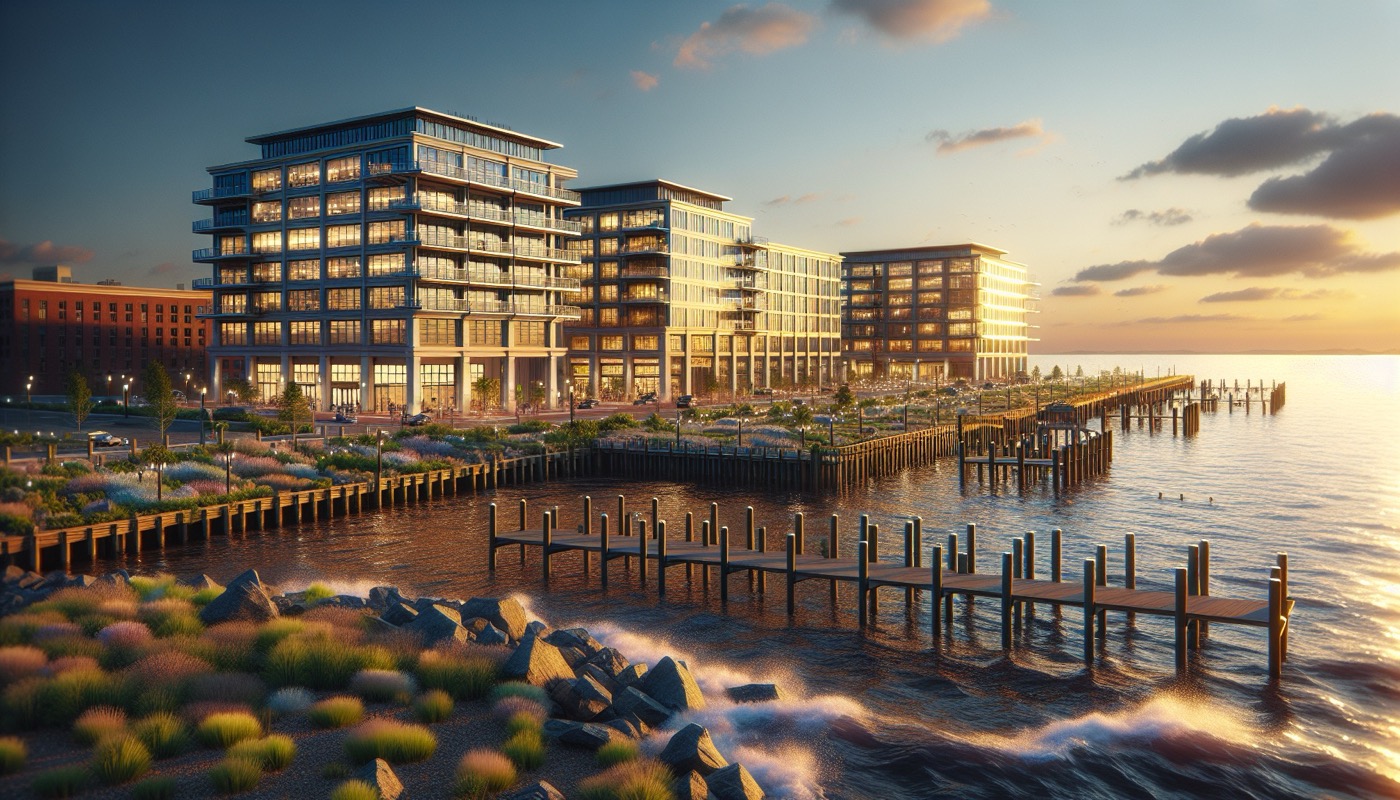
The Development Services Center and ePermit Center
Norfolk's Department of City Planning runs the Development Services Center (DSC) as the primary interface for commercial permits. All permit applications flow through the online ePermit Center:
- ePermit Center handles building, fire, sign, elevator, electrical, mechanical, plumbing, and zoning permits.
- Free account required; permits applied for and issued through the portal.
- Visa and Mastercard accepted for payment.
- Application submitted at norfolkvapermits.force.com.
- Construction plans — preferably single PDF — uploaded via Permit Portal or emailed to planreviewpermits@norfolk.gov after permit number issued.
Scope of commercial building permits includes drywall removal, new/relocated walls, new framing, re-roofing, siding, tenant build-outs, change of use/occupancy, additions, commercial accessory structures, fences over 6 feet, fire suppression, elevators, paint booths, service station islands/canopies, and pre-manufactured steel buildings.
Primary source: norfolk.gov (Development Services Center / ePermit Center).
Documentation and prerequisites
- Completed building permit application form.
- Contractor licensure affidavit.
- Asbestos certification or exemption form.
- Current City of Norfolk contractors' business license for projects over $25,000.
- Seal of registered architect or engineer for plans meeting VA Code § 54.1-402 thresholds.
- Prior approvals for new buildings from:
- Addressing — David.Vachet@norfolk.gov.
- Utilities — UTENGTECH@norfolk.gov.
- Right-of-Way — via PermitCity.
Architectural Review Board (ARB)
The ARB reviews exterior alterations, new construction, and some demolition in Norfolk's local historic districts:
- West Freemason Historic District — one of Norfolk's oldest neighborhoods.
- Downtown Historic District — the commercial core.
- Additional locally-designated historic properties.
Process:
- Certificate of Appropriateness (COA) issued on approval, required in addition to zoning certificate for any exterior modification.
- Standards: Secretary of the Interior's Standards for Rehabilitation plus Norfolk's Local Design Guidelines.
- Application types: new construction, additions, substantial renovations, signs, general rehabilitation.
- Administered by Department of City Planning.
Pattern is similar to Alexandria's BAR (see our Alexandria BAR essay) and Richmond's CAR (see our Richmond DPDR essay) — staff and board review with design-guideline basis.
The coastal resilience layer — what's unusual about Norfolk
Norfolk sits on the Elizabeth River with substantial tidal exposure, frequent nuisance flooding, and accelerating sea-level rise. The city's permit process reflects this:
Floodplain Development Permit
Required for any work in X Shaded, AE, AH, Coastal A, or VE flood zones before construction begins. No development may be used or occupied until the Floodplain Administrator approves compliance with floodplain regulations.
Elevation Certificates
Required for:
- New structures.
- Additions.
- Solar panels in flood zones.
- Garages.
- Pools (above or in-ground).
- Alterations converting space to habitable use.
Pattern: existing Elevation Certificate for additions/renovations; proposed-construction Elevation Certificate for new and substantial improvements.
Coastal Resilience Overlay (CRO) District
For projects within the CRO, Zoning Ordinance Section 5.12 imposes additional development standards:
- Ground floor height requirements above standard floor plate.
- Landscaping with native and salt-tolerant species.
- Resilience Quotient standards applicable to new development.
Resilience Quotient
With limited exemptions, all new development must meet Resilience Quotient standards. Quotient components vary by use; compliance typically demonstrated through Zoning Certificate via Site Plan review. This is where Norfolk pushes beyond standard USBC — requiring specific site, materials, and building-orientation choices tuned to flood risk.
Site Plan Review
Inter-departmental review triggered by:
- New construction.
- Substantial improvements.
- Additions to structures with 2,500+ sf land disturbance.
- Any land disturbance exceeding 2,500 sf.
Department of Public Works, Division of Environmental Storm Water Management reviews and approves site plans when land disturbance is significant or affects stormwater infrastructure.
How to determine what applies to a specific site
Norfolk Air (air.norfolk.gov) — the city's online mapping tool — lets applicants search an address and see:
- Flood zone status.
- Coastal Resilience Overlay District status.
- Historic district overlay.
- Zoning classification.
- Other overlays.
This is the first-step due diligence for any Norfolk commercial project. A parcel in CRO + historic district + AE flood zone is a materially different design effort than a comparable parcel without those overlays.
The practical commercial sequence
- Site due diligence via Norfolk Air — zoning, flood zone, CRO, historic status.
- Pre-application consultation with DSC and Planning as applicable.
- Historic district work — ARB COA process before building permit.
- Development in flood zone — Floodplain Development Permit.
- Development in CRO — Resilience Quotient compliance + CRO standards.
- Site Plan Review for larger projects or land disturbance thresholds.
- Contractor licensure — DPOR Class A/B/C (see our VA Class A/B/C essay) + Norfolk business license for >$25K projects.
- ePermit Center application with all prerequisites in place.
- Plan review iterations with Code Administration disciplines.
- Permit issuance + construction.
- Inspections per USBC + CRO standards + floodplain compliance.
- Certificate of Occupancy — including Floodplain Administrator approval where applicable.
Why Norfolk's model has outsized lessons
Norfolk's resilience framework is where other Mid-Atlantic cities are heading. As sea level rises and flood exposure expands, Baltimore, Philadelphia, Wilmington, and DC all face increasing pressure to impose Norfolk-style resilience standards on waterfront redevelopment. Contractors building experience in Norfolk are building experience in what commercial construction looks like under climate adaptation pressure.
Specifically, Norfolk's process illustrates:
- Site-specific resilience — ground floor elevation, landscape, building design decisions made at zoning level, not just at flood-elevation level.
- Integrated floodplain + resilience review — separate Floodplain Administrator sign-off from standard building permit.
- Resilience Quotient as point-based compliance — allowing design flexibility while ensuring minimum resilience performance.
- Interaction with USBC — USBC is the statewide code baseline (see our VA USBC essay); Norfolk's overlays layer on top of that baseline.
- Interaction with CBPA — Norfolk is one of the 84 CBPA Tidewater localities; projects in Resource Protection Areas face additional constraints (see our VA CBPA essay).
What out-of-town contractors should expect
- More overlays than typical. CRO + historic + CBPA + flood zones. Not unusual for a single project to engage all.
- Floodplain Administrator sign-off is a real step, not a box-check.
- Elevation Certificates need registered surveyor/engineer — schedule lead time.
- Resilience Quotient compliance affects schematic design; not a late-stage adjustment.
- Norfolk business license required for $25K+ projects — separate from state DPOR license.
- Site Plan Review for projects with 2,500+ sf land disturbance includes DPW stormwater review.
How Norfolk compares to peer VA cities
- Richmond. DPDR + OPP portal; CAR historic review; separate trade permits; statewide CBPA applicable. See our Richmond DPDR essay.
- Alexandria. BAR + DSP/DSUP + Code Administration via APEX. See our Alexandria BAR essay.
- Virginia Beach. Adjacent to Norfolk with overlapping coastal/CBPA context; different administrative structure.
- Fairfax County. DPS-centric, less coastal exposure, no CRO analog.
- Norfolk. Most developed coastal resilience framework in the region, ARB for small but notable historic core, ePermit Center unified portal.
What to do with this
If you're starting a Norfolk commercial project: Norfolk Air is your first tool. Map the overlays before committing design direction.
If you're in CRO: Resilience Quotient analysis + CRO-specific standards (ground floor elevation, landscape, orientation) at schematic, not at permit.
If you're in a flood zone: Elevation Certificate lead time, Floodplain Development Permit integration, and Floodplain Administrator sign-off on the schedule.
For broader VA context, see our VA USBC essay, VA CBPA essay, and VA VSMP essay.
About The Hive
The Hive builds tools and publishes essays for working construction and MEP professionals in the Delaware Valley and Mid-Atlantic. Primary-source-grounded, practitioner-voiced, free to use.