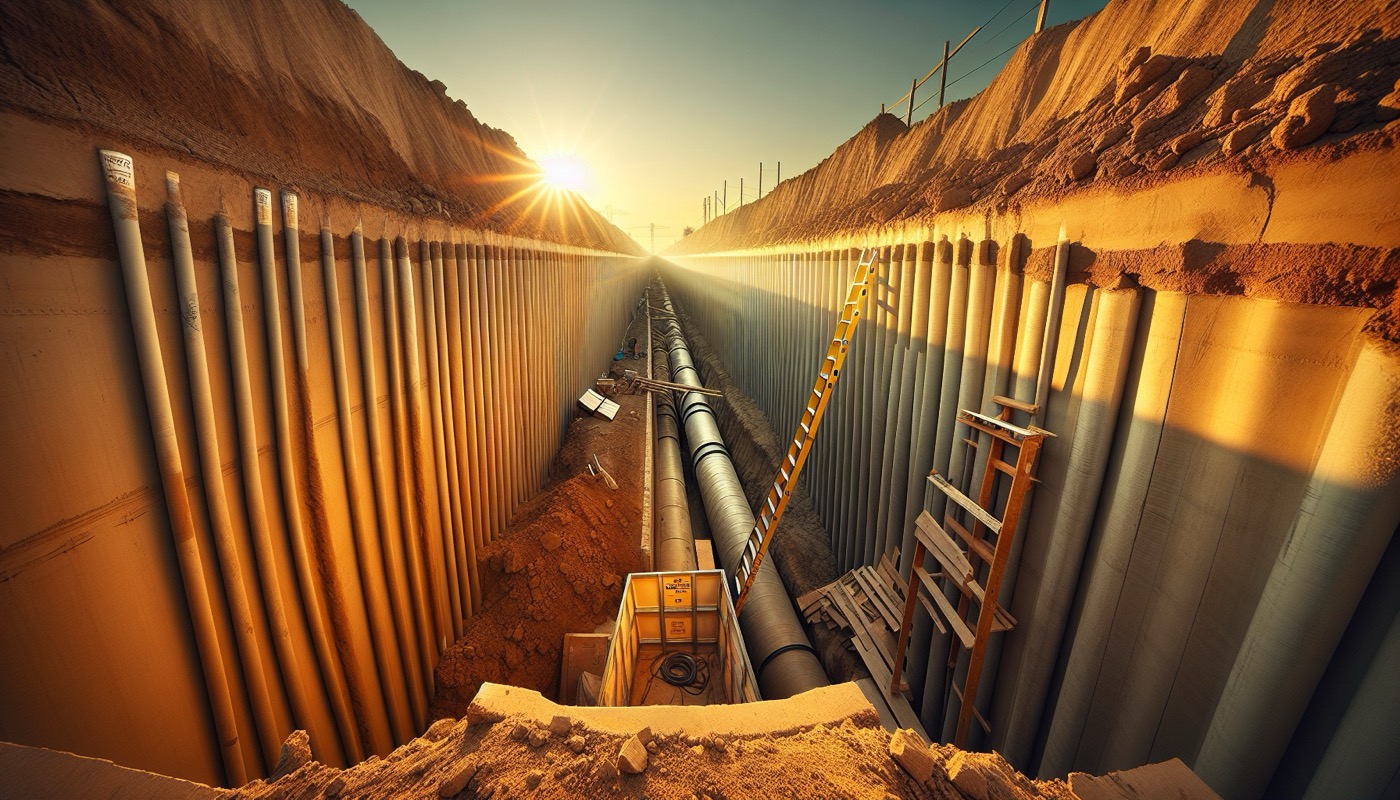
A cubic yard of soil weighs about as much as a compact car. That is the unit of risk in a trench. When a wall fails, the person inside has roughly the time it takes to read this sentence to get out, which is to say no time at all. OSHA's excavation standard exists because trench collapses kill faster than rescue can arrive, and almost every fatality is preventable with a protective system that the standard would have required.
Subpart P of 29 CFR Part 1926 — sections 1926.650 through 1926.652, with appendices — is the rulebook. It tells you when you need protection, what kinds count, who is qualified to design them, and who has to be watching on site. If you dig in the ground for a living, this is the standard that decides whether your crew goes home.
OSHA defines an excavation as any man-made cut, cavity, trench, or depression in an earth surface formed by earth removal. A trench is a narrow excavation (in relation to its length) made below the surface, generally deeper than it is wide and no wider than 15 feet at the bottom. Every trench is an excavation; not every excavation is a trench. Subpart P covers both.
The headline rule: any excavation five feet or more in depth requires a protective system, unless the excavation is made entirely in stable rock. At depths less than five feet, a Competent Person may determine protection is unnecessary based on a soil examination, but the default assumption in any deeper cut is that the walls will fail.
For cuts deeper than 20 feet, the protective system must be designed by a registered professional engineer, or selected from OSHA's appendices using tabulated data that a PE has approved. Below 20 feet, a Competent Person can select from the sloping, shoring, and shielding options the standard lays out directly.
The slope angles and shoring pressures in Subpart P all depend on what kind of soil you are cutting. Appendix A gives four categories:
A Competent Person must perform at least one visual and one manual test to classify the soil, and reclassify when conditions change — after rain, vibration, or the exposure of a different stratum.
You cut the walls back at an angle so they cannot cave. Maximum allowable slopes from Appendix B:
Benching (cutting stair-step sides) is permitted in Type A and B; not permitted in Type C. Above 20 feet, sloping designs must come from a PE.
Supports installed against the excavation walls to prevent movement. Timber shoring follows tabulated data in Appendix C; hydraulic and pneumatic shoring follow manufacturer data or Appendix D. Shores are installed from the top down and removed from the bottom up, with workers never entering an unshored section.
A trench box or shield — a steel or aluminum structure placed in the trench to protect workers if the walls collapse around it. Appendix E covers shield selection and use. The shield must extend at least 18 inches above the top of the vertical sides unless properly sloped above, and workers must enter and exit only within the shielded area.
OSHA requires that excavations, adjacent areas, and protective systems be inspected by a Competent Person — one who is capable of identifying existing and predictable hazards and who has the authority to take prompt corrective action. Inspections occur daily before each shift, after every rainstorm or other hazard-increasing event, and as needed throughout the shift. If the Competent Person sees evidence of a possible cave-in, failure of protective systems, hazardous atmospheres, or other hazardous conditions, workers are removed until conditions are safe.
Training is not OSHA-certified — there is no card — but the employer must be able to demonstrate competence through experience and knowledge of soils, systems, and the standard itself. This is the single most-cited qualification issue in Subpart P enforcement.
Subpart P's appendices are the field manual:
Appendix F is the decision tree — start with soil type, apply depth, choose sloping, shoring, or shielding, verify against the appropriate appendix.
If you remember three numbers, you remember most of Subpart P. Five feet — protection required. Twenty feet — PE required. Twenty-five feet — maximum lateral travel to egress.
If you remember one rule, it is this: never enter a trench that is not protected, and never assume the soil is better than it looks. The engineer on the drawing and the competent person in the field both exist because the ground does not care about the schedule.
OSHA's primary sources for this essay: 29 CFR 1926.650 (scope and definitions), 29 CFR 1926.651 (specific excavation requirements), 29 CFR 1926.652 (protective system requirements), and the six appendices. The OSHA Trenching and Excavation Safety publication (OSHA 2226) is the practitioner-facing companion.