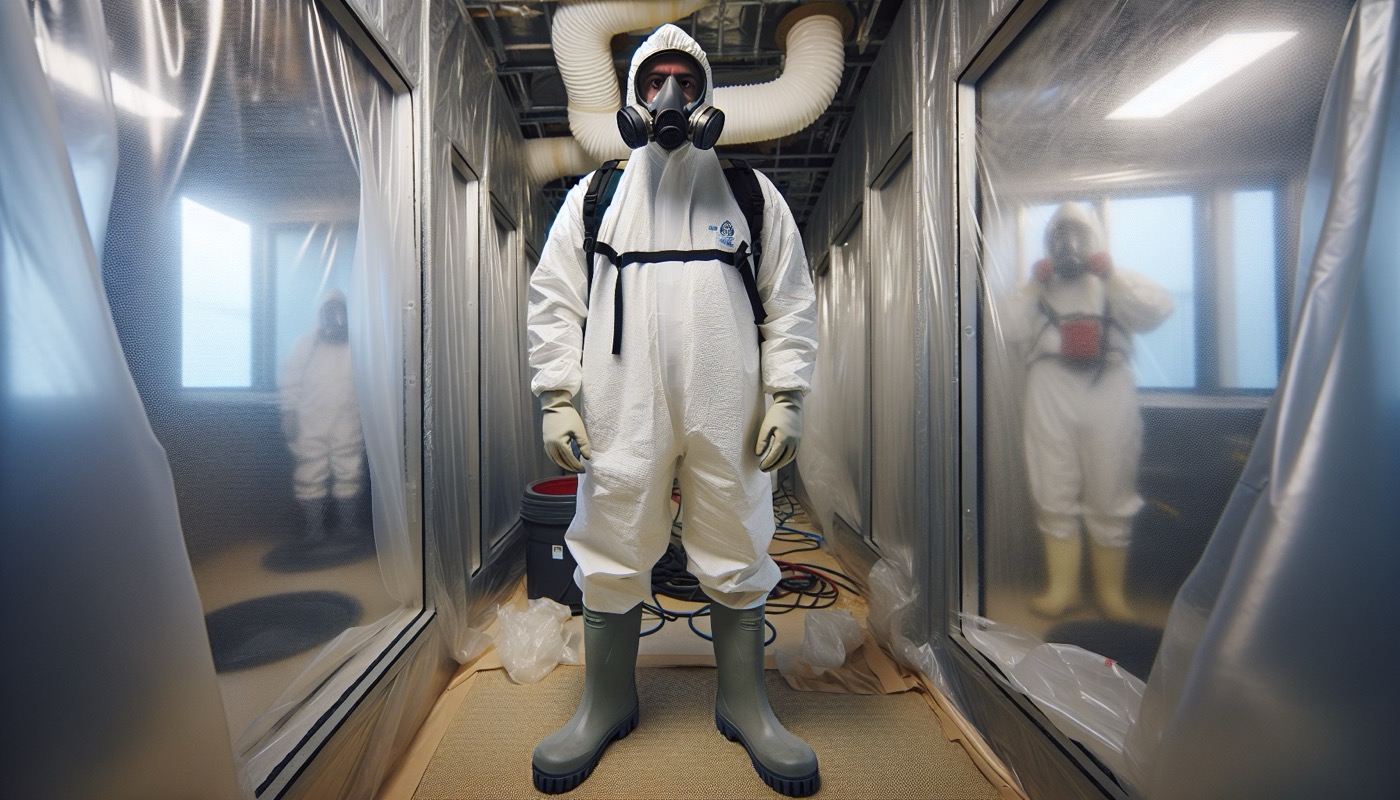
Every demolition or renovation of a building with asbestos-containing materials in the Mid-Atlantic runs through two federal regimes in parallel: EPA's NESHAP Asbestos (40 CFR Part 61 Subpart M) for regulated-asbestos waste handling and building-air emissions, and OSHA's Asbestos in Construction standard at 29 CFR 1926.1101 for worker protection. See our NESHAP Asbestos essay for the EPA side. This essay covers the OSHA side — the most detailed federal construction worker-safety standard in terms of prescriptive requirements, with a task-based classification system that is distinctive among OSHA substance-specific standards.
Exposure levels at which OSHA 1926.1101 obligations trigger:
These are asbestos-fiber air concentrations, measured by PCM (phase-contrast microscopy) on filter media — the standard occupational-hygiene method. The numeric limits have not changed since 1994.
OSHA 1926.1101 organizes covered work around four task classes, each with progressively less stringent requirements:
Activities involving the removal of Thermal System Insulation (TSI) — boiler lagging, pipe insulation, duct insulation — and Surfacing ACM/PACM (fireproofing, textured finishes, sprayed-on coatings). Class I is the most hazardous class and requires the most stringent controls:
Removal of non-TSI, non-Surfacing ACM — floor tile, ceiling tile, roofing, siding, transite, gaskets. Requirements are scaled down but still substantial:
Small-scale maintenance or repair — plumbing repair through a ceiling suspected of ACM tile, electrical work through an ACM wall. Controls include:
Cleaning up asbestos-containing waste or debris deposited by Class I, II, or III activities. Class IV workers are not performing abatement but may contact residual asbestos:
For pre-1980 buildings, the standard introduces Presumed Asbestos-Containing Material (PACM) — materials presumed to contain asbestos unless tested to the contrary. PACM includes TSI and Surfacing materials installed in buildings constructed before 1981. Employers and building owners must treat PACM as ACM unless they have bulk sample analysis demonstrating less than 1% asbestos.
Building owners have related obligations under paragraph (k): identify and communicate PACM to tenants, employees, contractors, and others who may disturb it. This is often where pre-demolition asbestos inspections are coordinated — one survey satisfies both OSHA PACM identification and NESHAP pre-demolition inspection.
Under paragraph (o), a Competent Person — trained to identify asbestos hazards and authorized to take corrective action — must be on site for Class I, II, and III work. Competent Person training typically includes a 40-hour asbestos supervisor course (meeting EPA AHERA training requirements) plus site-specific experience. Many Mid-Atlantic states require state-level asbestos supervisor certification in addition to the federal training floor.
Wherever airborne asbestos concentrations exceed the PEL or where Class I/II/III work is performed, a regulated area is established:
Paragraph (j) specifies decontamination facilities by class. For Class I:
For Class II and III, smaller decontamination arrangements are permitted based on the specific operation.
Per OSHA's Respiratory Protection standard (see our Respiratory Protection essay), respirators are selected based on airborne concentration and APF. For asbestos:
OSHA's default for Class I without air monitoring is respirator APF of at least 50.
Paragraph (m) requires medical surveillance for employees exposed at or above the PEL for 30 days or more per year, or for employees who engage in Class I, II, or III work for 30 days or more per year, regardless of exposure level:
Class-specific training requirements:
Training content covers physical characteristics of asbestos, respirator use, work practices, decontamination, medical monitoring, and emergency procedures. Many Mid-Atlantic states require state certification on top of federal training — Maryland, Virginia, New Jersey, and Pennsylvania administer state asbestos certification programs.
On any asbestos demolition or renovation, OSHA 1926.1101 and EPA NESHAP (40 CFR Part 61 Subpart M) both apply:
Both regimes require the same pre-demolition/renovation asbestos inspection. Both recognize similar material categories (friable vs non-friable, ACM vs PACM). The two are typically administered on a single project by one certified asbestos abatement contractor, with one Competent Person, and unified pre-job paperwork. See our NESHAP Asbestos essay for the EPA side.
In the Mid-Atlantic, asbestos abatement contractors typically need state-level licensing or certification:
State licensure is in addition to OSHA and EPA requirements. A contractor working in multiple states holds licenses in each.
Three practical rules:
Asbestos work is a compliance-intensive corner of construction. The rules are specific, the documentation is detailed, and state oversight is close. Build the compliance package once for the contractor, apply it across projects, and keep training and medical surveillance current.
Primary sources for this essay: 29 CFR 1926.1101 (Asbestos in Construction); OSHA Small Entity Compliance Guide; 40 CFR Part 61 Subpart M (NESHAP Asbestos); EPA AHERA regulations (40 CFR Part 763); state asbestos programs referenced above. OSHA's Technical Manual Section III Chapter 1 (Asbestos) and Model Accreditation Plan training standards are practitioner companions.