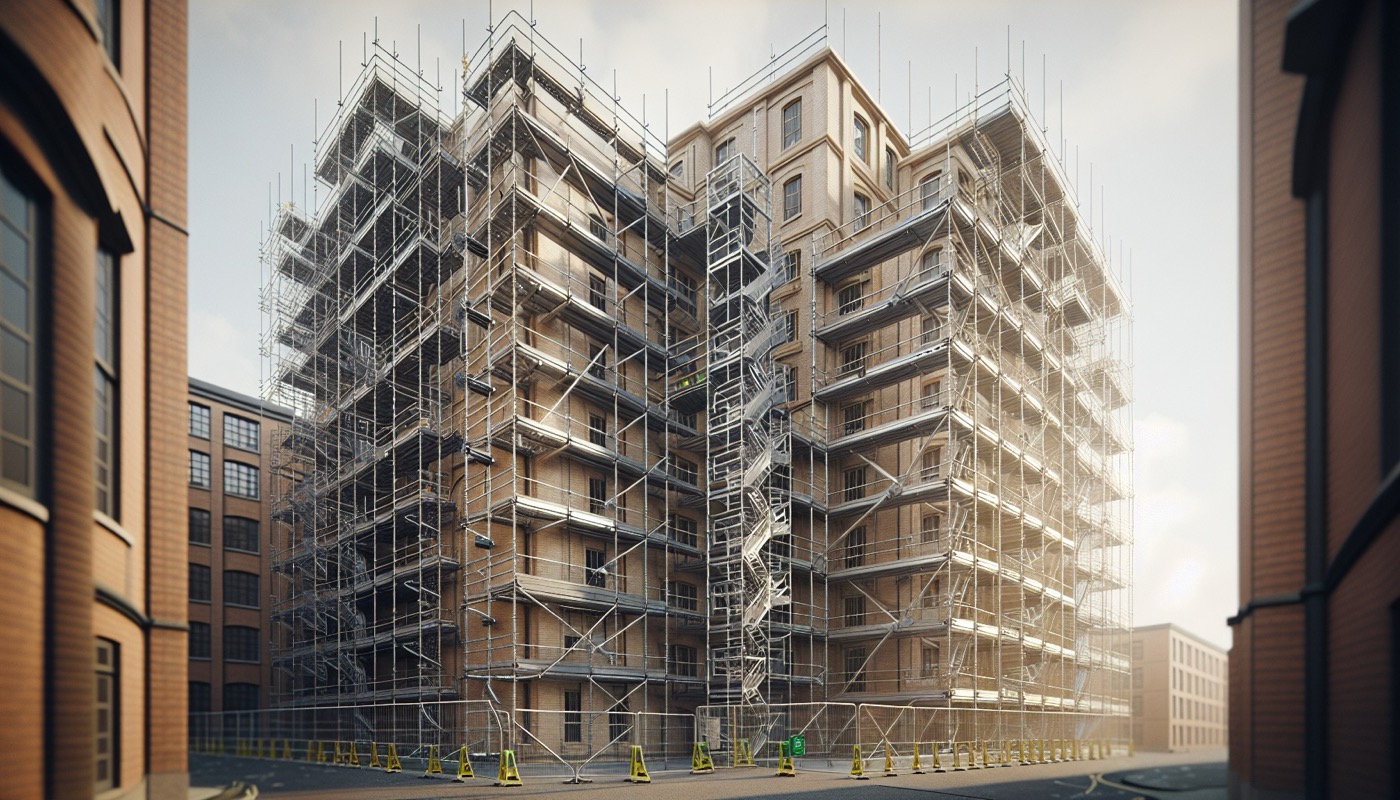
Scaffolding sits inside OSHA's Fatal Four every year. Not because the rules are unclear — Subpart L of 29 CFR 1926 is one of the most detailed standards in construction — but because scaffolds get assembled under time pressure, inspected casually, and used by people who did not erect them. The standard exists to force a pause: capacity before the deck goes down, inspection before the shift starts, fall protection before the first boot steps on.
The core sections are 1926.450 (scope and definitions), 1926.451 (general requirements — the longest section in Subpart L), 1926.452 (requirements for specific scaffold types), 1926.453 (aerial lifts), and 1926.454 (training).
Every scaffold and every scaffold component must be capable of supporting, without failure, its own weight and at least four times the maximum intended load applied or transmitted to it. Suspension scaffold rigging gets a stricter multiplier — suspension ropes must support at least six times the maximum intended load.
Maximum intended load includes workers, equipment, tools, materials, and any other loads the scaffold is designed to carry. This is not a nominal rating — it is the live-load number the erector planned for, and the scaffold has to survive four times that before it fails. In practice this is why a Qualified Person (defined below) designs loading for any non-routine use.
Fall protection is required on any scaffold more than ten feet above a lower level. That is a different trigger than Subpart M's six-foot rule for general construction — scaffolds get their own threshold because the working surface is already engineered.
Options depend on scaffold type:
Guardrail top-rail height: 38 to 45 inches (the standard was updated from the older 42-inch figure to allow a tolerance). Midrails at roughly mid-height. Toe boards where anyone could be below.
Working platforms must be fully planked or decked between the front upright and the guardrail, with no more than a one-inch gap. Platforms must be at least 18 inches wide (narrower allowed only where the work area makes 18 inches impractical, and fall protection is still required).
Planks extend over their end supports by no less than 6 inches and no more than 12 inches, unless the plank is cleated or restrained. The 14-inch gap rule: the front edge of a platform cannot be more than 14 inches from the face of the work (3 inches for plastering/lathing, 18 inches for outrigger scaffolds), unless a guardrail or PFAS is used.
When the platform is more than two feet above or below a point of access, a means of access is required. Cross-braces are not acceptable as a means of access. Options: portable ladders, hook-on ladders, attachable ladders, stair towers, stairway-type ladders, ramps, walkways, integral prefabricated scaffold access, or direct access from another scaffold, structure, or personnel hoist.
Subpart L splits responsibility between two roles the standard defines differently:
Competent Person — capable of identifying existing and predictable hazards and with authority to correct them. A Competent Person must:
Qualified Person — by possession of a recognized degree, certificate, or professional standing, or by extensive knowledge and experience, has successfully demonstrated ability to solve problems relating to the subject matter. A Qualified Person:
The Competent Person watches the job. The Qualified Person — often a registered PE or manufacturer's engineer — signs off on the design.
OSHA does not require the green / yellow / red tag system. It requires inspection by a Competent Person before each shift. The tag system is the industry's operational implementation:
If you use tags, you must use them consistently. OSHA will cite tag misuse as a failure of the Competent Person's inspection duty.
Section 1926.452 covers 25 distinct scaffold types with type-specific rules. The most common on construction sites:
Two training duties, both employer-borne:
Retraining is required when changes render previous training obsolete, when there is a change in scaffold type or fall protection, or when employer observations reveal training deficiencies.
Three numbers carry most of Subpart L: 4× for component capacity, 10 feet for fall-protection trigger, and 38–45 inches for guardrail height. Two people carry the rest: the Competent Person who inspects every shift, and the Qualified Person who signs off on anything non-standard.
The most-cited scaffolding violations every year are the same three: no fall protection, no access, and inadequate guardrails. None of those are design problems. They are inspection problems. The standard exists because someone has to look before anyone climbs.
OSHA's primary sources for this essay: 29 CFR 1926.450 through 1926.454 and OSHA Publication 3150 ("A Guide to Scaffold Use in the Construction Industry"). Letters of Interpretation clarify tagging practice, mobile-scaffold rider rules, and suspension-rope capacity.