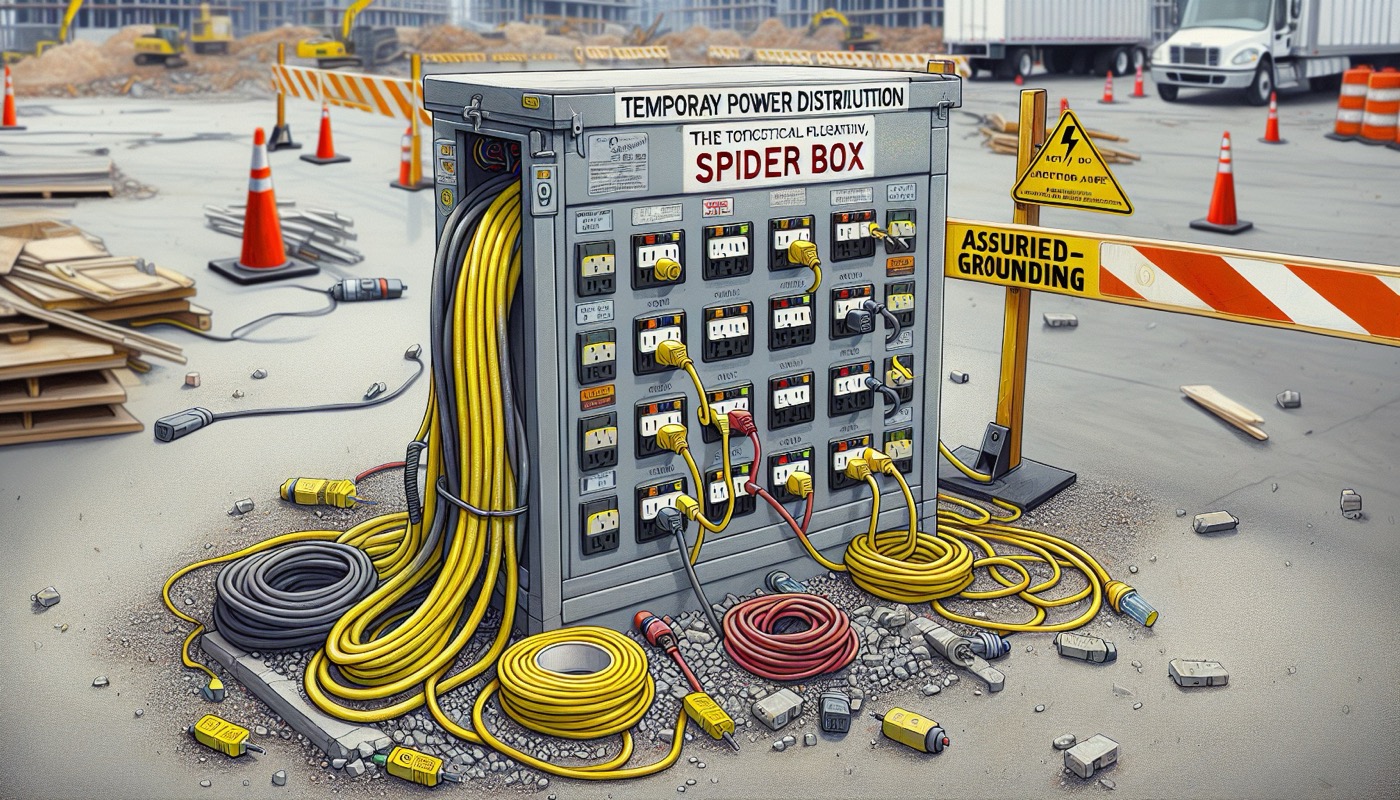
Electricity accounts for roughly one in ten construction fatalities every year — most from contact with overhead power lines, most of the rest from contact with energized equipment the worker believed was dead. Subpart K of 29 CFR 1926 is OSHA's answer: a tiered framework built around isolation, verification, and distance.
Subpart K runs from 1926.400 through 1926.449, organized into four groups: installation safety (.402–.408), safety-related work practices (.416–.417), safety-related maintenance and environmental considerations (.431–.432), and safety requirements for special equipment (.441). A fifth piece — definitions — lives at 1926.449.
OSHA's Subpart K is the enforceable standard. NFPA 70E is the consensus document OSHA cites when determining whether a practice is "recognized" for General Duty Clause purposes. In practice, sites that follow 70E (arc-flash labeling, PPE categories, energized-work permits) exceed Subpart K's minimums and give the employer a defense if a citation is contemplated.
§ 1926.404(b)(1) requires one of two methods on 120V, single-phase, 15- and 20-ampere receptacles used by employees at construction sites:
Ground-Fault Circuit Interrupters on all 15/20-amp, 120V receptacles that are not part of the permanent wiring. Most sites pick this path because GFCIs are cheap, portable cord caps exist, and there is no paperwork.
A written program under which each cord set, receptacle, and cord-and-plug-connected equipment not part of the building wiring is inspected for damage before each day's use and tested:
Tests: continuity of the equipment grounding conductor, and correct attachment of the grounding conductor. Results must be recorded. A Competent Person administers the program.
The practical rule: if you are not running an assured grounding program in writing, you are on the GFCI path — and every temp-power receptacle a worker plugs into must have GFCI protection.
Subpart K references 1926.417 — "Lockout and tagging of circuits" — which requires that controls deactivated during maintenance or repair be tagged, and energy sources rendered inoperative where appropriate. Where OSHA's general-industry 1910.147 (control of hazardous energy) applies by analogy, OSHA will cite it via the General Duty Clause if 1926.417 alone is inadequate.
The safe sequence: notify, shut down, isolate, lock, tag, try (verify dead with a meter that has been proven live-dead-live on a known source), then work. This "live-dead-live" verification is a 70E practice OSHA will cite under General Duty when it is skipped.
§ 1926.1408 (Subpart CC, cranes) and § 1926.416(a) (Subpart K, general) both address the same risk. The general Subpart K rule: no employee may work in such proximity to any part of an electric power circuit that the employee could contact the electric power circuit in the course of work, unless the employee is protected by de-energizing and grounding, or by effective insulation.
The well-known numbers come from the crane rule and OSHA's general industry 1910.333 table, but the construction practical minimum is:
If you can't guarantee the distance, the line must be de-energized and grounded by the utility, insulated, or physical barriers erected. Spotters are required for mobile equipment near lines. Ladder and scaffold work near overhead lines is governed by the same clearances.
Subpart K distinguishes:
Qualified does not mean "licensed electrician." It means trained in the specific equipment, the specific hazards, and the specific procedures for the task at hand. Electrical training must be documented.
§ 1926.405(a)(2)(ii) and § 1926.405(g) limit flexible cord use. Flexible cords may not be used:
Cords must be hard-service (S, SJ, or equivalent designation) for construction use. Damaged cords must be taken out of service immediately — not taped.
The baseline rule: de-energize before working. Energized work is allowed only when de-energizing introduces additional or increased hazards (life-support equipment, ventilation in a hazardous location, illumination circuits for emergency egress) or when infeasible due to equipment design or operational limitations.
When energized work is necessary, the employer must have a written energized electrical work permit documenting justification, PPE, approach boundaries, and Qualified Person assignment. OSHA does not prescribe the permit form; 70E provides the template the industry uses.
Subpart K does not contain an "arc flash standard" with explicit boundaries. OSHA regulates arc-flash hazards through:
Enforcement in the field: OSHA inspectors evaluate whether arc-flash labeling, PPE category selection, and boundary observance follow 70E. Where they do not, a citation typically reads § 1926.416(a)(1) with 70E in the accompanying narrative.
Three decisions carry most of Subpart K. GFCI or assured grounding — pick one and actually do it. De-energize first — and prove it with a meter before you touch anything. Ten feet — away from any overhead line you have not verified as de-energized and grounded by the utility.
Everything else in the standard is the mechanics of enforcing those three decisions. Most electrical fatalities in construction happen when one of them was skipped — almost never because the rule was unclear.
OSHA's primary sources for this essay: 29 CFR 1926.400–.449 (Subpart K), 29 CFR 1926.1408 (crane proximity to power lines), and NFPA 70E (consensus standard cited under General Duty). OSHA's Temporary Wiring eTool and Publication 3075 ("Controlling Electrical Hazards") are the practitioner-facing companions.